

8 Undervalued & Overlooked Vintage HOF Baseball Players (1950s – 1960s)
Summary
Vintage baseball card collectors know that Mantle, Mays and Aaron cards can break the bank. There are other Hall of Famers from this period with cards that almost seem ridiculously cheap in comparison.
The current trend in vintage sports cards and related collectibles favors the “Grails” and “GOATs” above and beyond cards of other players. It’s no shock that Mickey Mantle, Willie Mays, Hank Aaron, Roberto Clemente, Ted Williams and Jackie Robinson dominate the vintage sports collectibles segment in the hobby from the 1950s (or into the 1960s). What is at least a little surprising after all these years is just how many other great Hall of Fame players are simply forgotten, overlooked or not even collected outside of their rookie cards. Some of those players are even in the 500 Home Run Club or were the best player on their team for years!
If you want to buy rookie cards, particularly in grails and GOATs, you already know you can easily spend more than most people can afford as condition gets into high-grade examples. You can get to $5,000 or $10,000 without much difficulty. That’s just not necessarily the case for other undervalued/overlooked Hall of Fame player cards. Many of their cards after their rookie cards can be purchased for a tiny fraction of the price of their Grail/GOAT contemporaries.
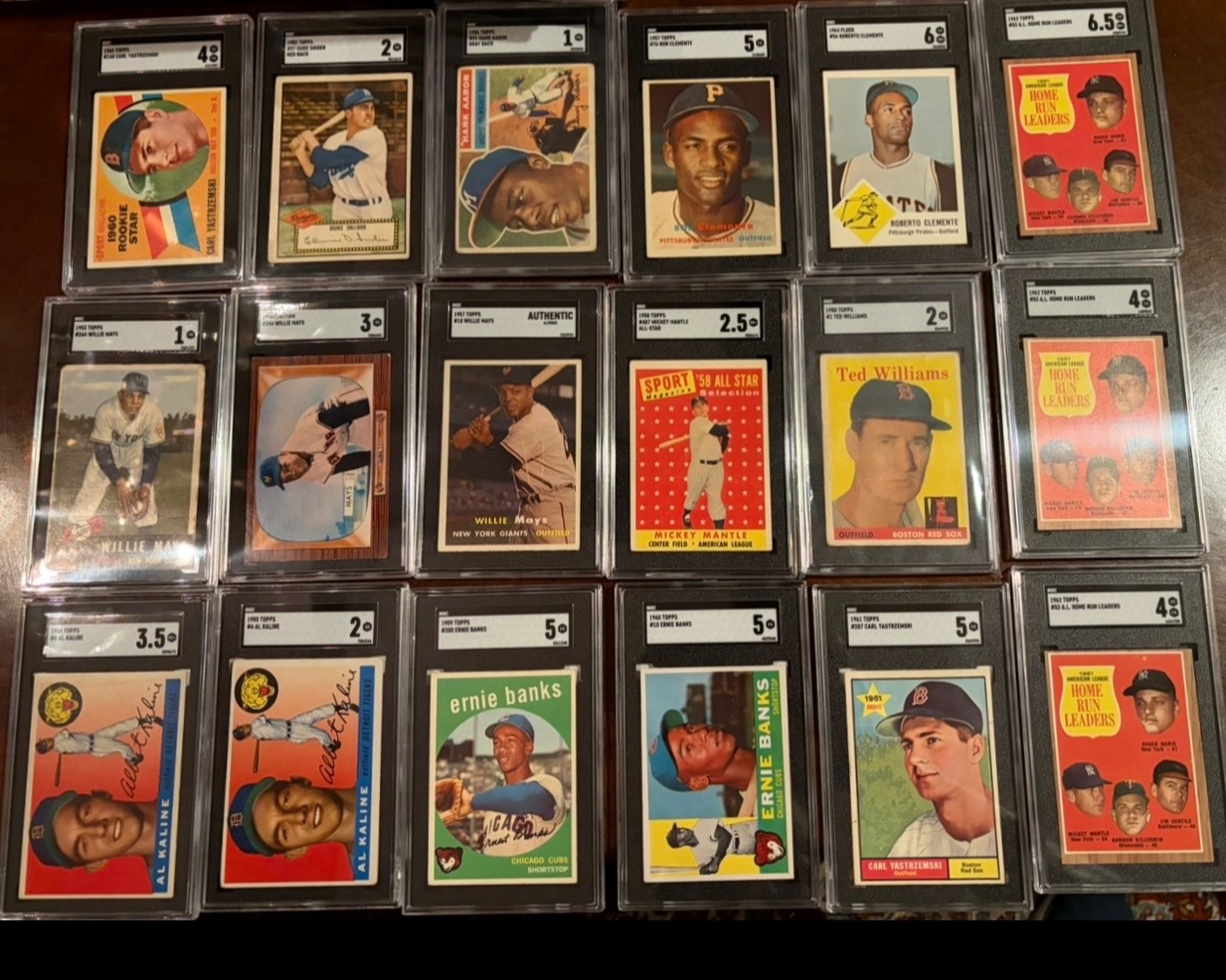
The list of undervalued and underappreciated players from Ogg’s Cards features players who were literally good enough to build a team around AND with card values that just aren’t over the top. This list pertains solely to those players who were not on the pitching mound who played in the 1950s into the 1960s or even into the 1970s. As far as what defines “affordable” may be different to every collector, but in this sense — cards under $100, $200 and up to $300 (or so). The idea is not to define prices today because they can all change over time.
Before getting into players who are undervalued or are underappreciated, make sure you aren’t expecting that the prices of these cards are going to magically scream higher. If the trends toward grails/GOATs remain in place, which seems likely, then the prices of undervalued and underappreciated players are likely going to remain relatively underappreciated and undervalued. So, here is a list of some of those great underappreciated and undervalued players:
- Ernie Banks
- Yogi Berra
- Al Kaline
- Harmon Killebrew
- Eddie Mathews
- Stan Musial
- Brooks Robinson
- Frank Robinson
The card grading logjam of 2026 likely means that lesser HOF players’ cards may see their overall graded card populations remain static or grow very slowly for an extended period of time. Grading costs and long wait times to receive a card back from PSA, SGC and Beckett have made it prohibitive to be worth grading many lower-priced cards. Think about this as a collector: if you have a PSA 5 graded card worth $75 to $100 already graded, are you willing to spend $50 to $100 after shipping and insurance costs after buying a raw example to get it slabbed? That extended period of time to wait for value grades is not likely to go away any time soon.
Another shocking aspect of “overlooked and affordable” player cards is how cheap some of their autographed cards sell for. Collectors don’t seem to bat an eye paying $100 to $200 for current star autographs at card shows and other signing events, and modern stars are going to be signing for years or decades into the future. If your favorite vintage players are no longer alive, do you ever have to worry about when their next appearance is or what their signing fee is?
Be advised that this is not intended to be “sports card investment advice” of any kind. If that is what you are looking for, you came to the wrong place. It’s also certainly no prediction that these players’ cards will never fall in value. If you are investing in cards or collecting cards, what you choose to purchase is solely up to you and you alone.
It should also be stated that other card dealers and card collectors may have a different list of their own “undervalued and underappreciated” players — and some might disagree with the players on this list.
ERNIE BANKS
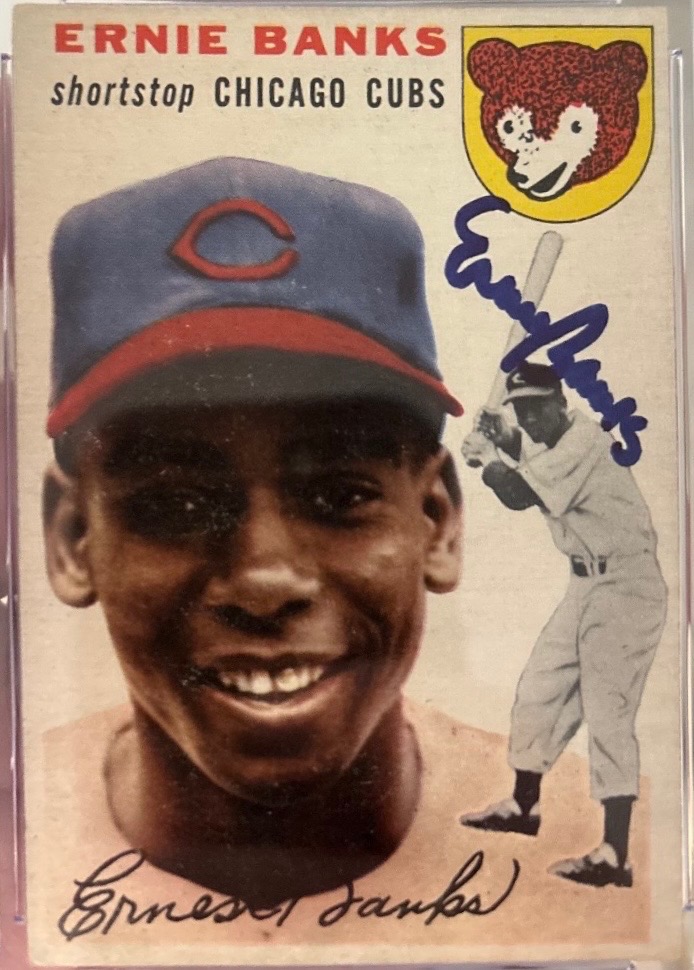
Ernie Banks was a lifelong player for the Cubs, earning the nickname “Mr. Cub.” His career debut was in 1950 in the Negro Leagues for the Kansas City Monarchs at the ripe age of 19. Banks was the first African-American to play for the Cubs, after serving in the Army as an artilleryman and battalion flag bearer while also spending service time in Germany.
Banks ended his career with a .274 batting average, but he hit over 40 homers in five seasons and leading the NL twice in both homers and RBIs. His career ended with 2,583 hits, 1,305 runs scored and 1,636 RBIs and he ended with 512 career homers. While he struck out 1,236 times in his career, he also had 736 walks and on on base (OBP) of .330. He was on 14 NL All-Star teams and he won MVP awards twice (’58/’59). His fielding prowess also earned him a Gold Glove Award in 1960, and his career was split between shortstop and first base. Perhaps Banks’ biggest flaw as a player, at least as far as affecting his collectability outside of his rookie card, is that he never got to play in the World Series. In fact, the Cubs were just not even a good enough team for Banks to ever even get to play once in the MLB playoffs. It seems logical that Banks would be much more sought after by collectors if the Cubs had better-rounded teams.
The only truly “expensive” Topps card of Ernie Banks is his rookie from the 1954 Topps set (featured above), and playing only 10 games in September of 1953 barely allowed that rookie card to exist. That 1954 rookie card even referred to Banks as a “hot prospect.” His 1955 Bowman card and the 1956 cards have become more expensive in stronger grades, but Banks’ 1957 to 1959 Topps cards are still very affordable. After those years, from 1960 onward Banks’ baseball cards become even that much more affordable unless they are in high-grade condition. The 1971 Topps card of Ernie Banks is his last card as a player, and even with the grading difficulties notorious for the black borders this card only gets pricey up in higher grades.
YOGI BERRA
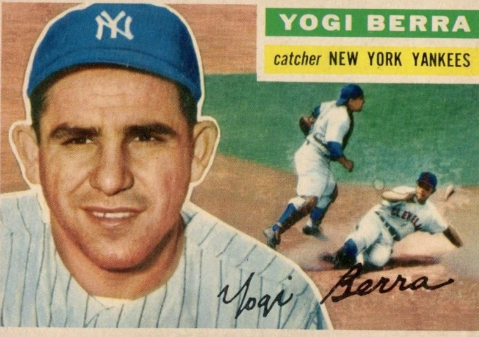
Berra may be one of the best catchers of all-time, but he certainly dominated among catchers in the 1950s and even into the 1960s. Perhaps what should really stand out about Yogi is that he caught and won a record 10 World Series titles as a player. Bob Euker may have been considered the funniest and goofiest of players over time, but Berra’s endless “Yogi-isms” made him famous on and off the field for decades. And in his post-player career he managed the Yankees and Mets in seven different seasons (6 full seasons) – and he also had coaching roles in other years with the Mets, Yankees and Astros.
Berra ended his career with a .285 batting average and was one of the best power-hitting catchers of his era. He hit 30 or more homers twice and drove in 100+ runs five times. His career ended with 2,150 hits, as well as 1,175 runs scored and 1,430 RBIs, and he finished with 358 career homers. Berra was a remarkably tough out for pitchers, striking out only 414 times in 19 years while drawing 704 walks, with an OBP of .348. He was named to 18 AL All-Star teams and won three MVP awards (‘51/’54/’55). He played almost his entire career at catcher for the Yankees. And for those collectors who enjoy seeing military service, the then 19‑year‑old Berra served as a U.S. Navy gunner’s mate aboard an attack transport loading and firing both machine guns and rocket launchers under heavy fire to help clear the way for soldiers storming the beach in the Normandy D-Day landings in 1944. The Berra “It Ain’t Over” documentary from 2022 will explain his life and career better than these two paragraphs can even attempt in summary.
Berra does have cards that can be expensive — his rookie card is the 1948 Bowman, and his early 50s cards from Topps and Bowman can still be somewhat pricey up until 1954/55. Where his cards get affordable is after the 1955 Topps set as a high-number card in the set and certainly after the 1956 Topps set. From 1957 on, his cards are not bank-breakers until higher graded examples. Still, his 1957 Topps “Yankees’ Power Hitters” card can be expensive due to some teammate named Mickey Mantle posing with him in the dugout. Most of Berra’s cards in the late-1950s and 1960s are just not generally expensive considering his pedigree. The 1965 Topps set is the last card with Berra listed as a Catcher-Coach with stats showing he “did not play” in 1964. His 1964 Topps card even displayed the news he would manage the Yankees. His cards from the 1970s and 1980s as a manager are very inexpensive by any collecting standards.
AL KALINE
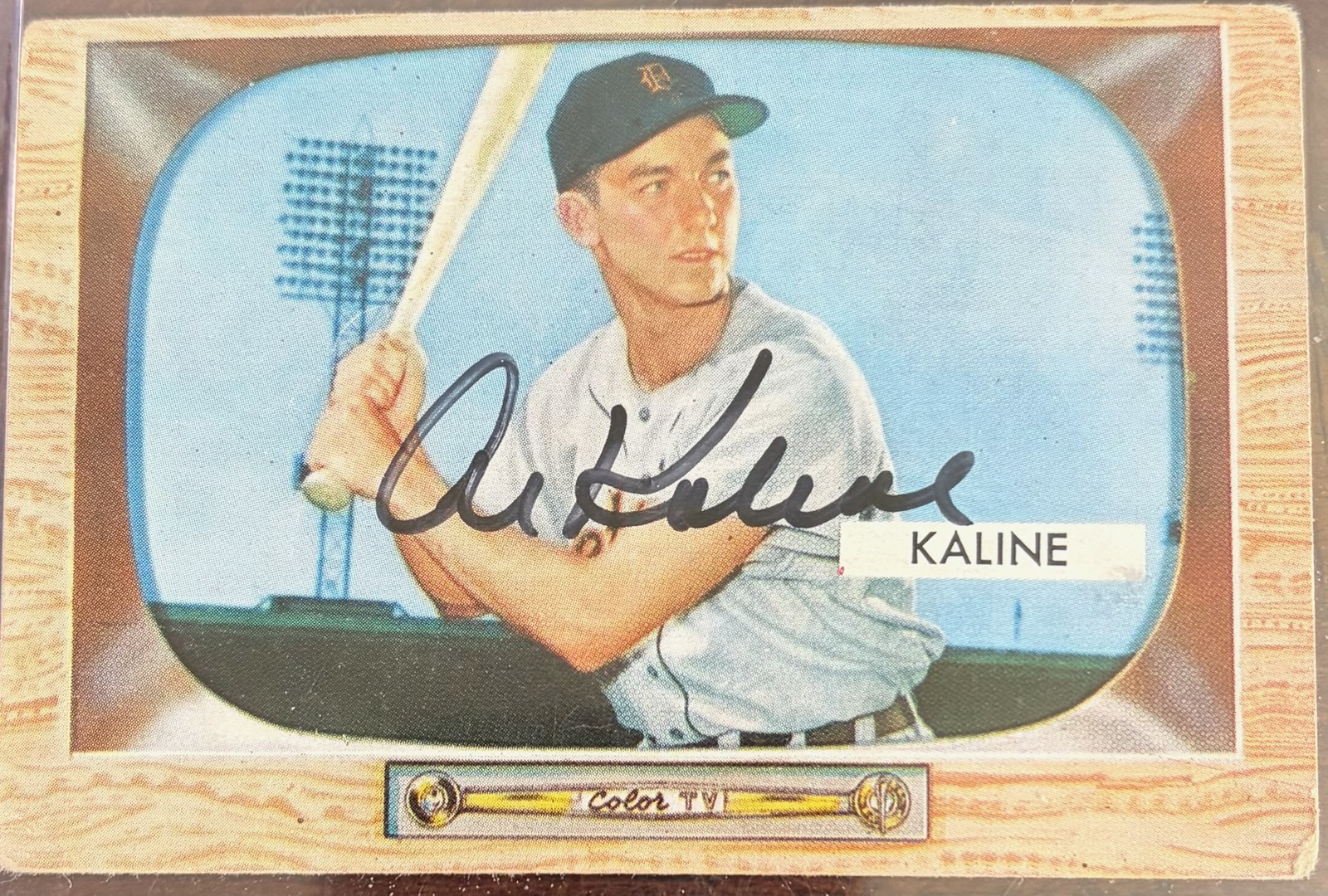
Al Kaline ended his career with a .297 batting average and won the AL batting title in 1955 at just 20 years old, hitting .340. He became known as “Mr. Tiger” and unsurprisingly spent all of 22 seasons in Detroit. His career ended with 3,007 hits, 1,622 runs scored and 1,583 RBIs, and he finished with 399 career homers. He struck out 1,020 times but drew 1,277 walks, with an OBP of .376. He was named to 18 AL All-Star teams. His defense in right field earned him 10 Gold Glove Awards. Kaline also helped Detroit win the 1968 World Series. His popularity is stronger in the Midwest as a career Tiger player, but Kaline also became a TV color commentator and later was front office assistant for the Tigers.
Kaline’s only expensive card by most measures is his 1954 Topps rookie, but even then only in mid-grade and higher graded examples. His mid-grade cards from 1955 Bowman and from 1955-’56 Topps can still be relatively affordable in mid-grade examples. Kaline’s cards from 1957 Topps onward can be found for under $100 in mid-grades, and more affordable than that in low-grade examples. Almost every Kaline card from the 1960s will not break the bank by any measures, and in the early 1970s cards you will have to get into high-graded examples before three-figure dollar sales have to come into play. The reality is that Kaline was a household name around Detroit and nearby Midwest markets, but outside of those markets or with collectors who have ties there his cards just aren’t sought after by the collecting community nationwide.
HARMON KILLEBREW
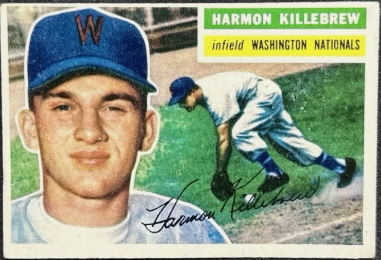
Killebrew ended his career with a just .256 batting average, but he hit over 40 homers in eight seasons. He led the AL six times in homers and three times in RBIs. His career ended with 2,086 hits, 1,283 runs scored and 1,584 RBIs, and he finished with 573 career homers. He struck out 1,699 times, but his 1,559 walks gave him an OBP of .376. He was named to 13 AL All-Star teams and won the MVP award in 1969, when he hit 49 homers and drove in 140 runs. He split his career among third base, first base and left field, mostly with the Senators/Twins franchises.
Having the nickname of “the Killer” has not translated to most collectors chasing his cards. Even the rookie 1955 Topps card does not fetch more than $150-200 in grades 1 and 2, but they do get elevated from there in mid-grade and can get pricey in high-grade examples — showing only 9 games played in the ’54 season and referring to him as a prospect. From 1956 onward through 1959, collectors can routinely find lower to mid-grade cards at very reasonable prices. And from the 60’s onward, even mid-grade and some higher-grade cards may be found easily for under $100. And approaching the 1970s cards, only very high-graded examples for set-builders and regional collectors will even have to think about anything of $100 or over. Perhaps playing for the Senators, who then moved to become the Nationals and then the Twins is why most collectors just skip his cards.
EDDIE MATHEWS
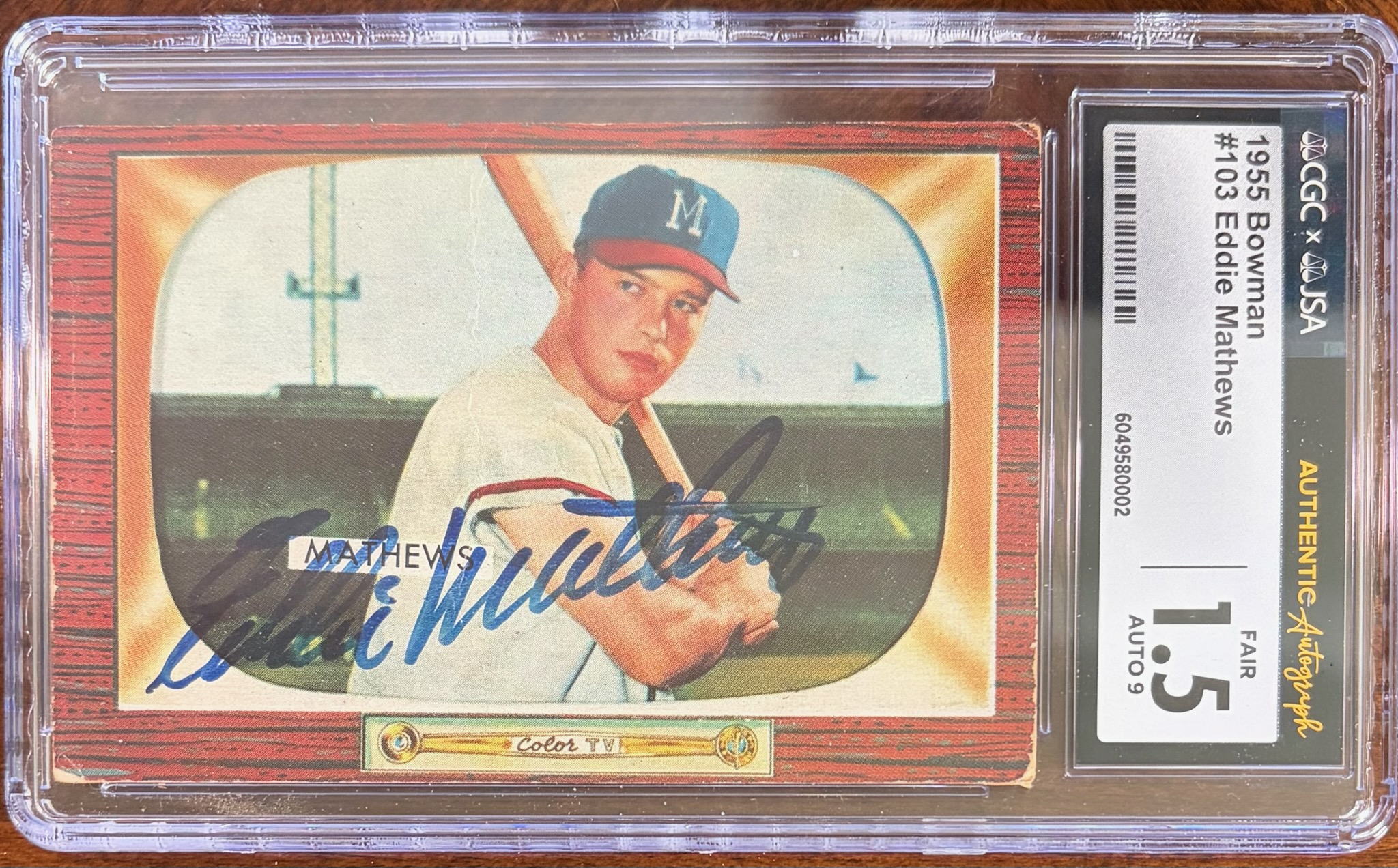
Mathews ended his career with a .271 batting average, but he hit over 40 homers in four seasons. He led the NL twice in homers (‘53/’59). His career ended with 2,315 hits, 1,509 runs scored and 1,453 RBIs, and he finished with 512 career homers, the same total as Banks. He struck out 1,487 times but drew 1,444 walks, for an OBP of .376. He was named to 12 NL All-Star teams and twice finished second in MVP voting, though he never won the award. He played almost exclusively at third base, mostly for the Braves before being traded around, and won World Series titles in 1957 and 1968. One key issue about Mathews is that he was part of the Braves’ power-hitting duo with some guy named Hank Aaron.
The only truly expensive Eddie Mathews card is his 1952 Topps #407 rookie. It was the last card of that set and there are barely 1,000 graded examples at PSA (most of which have severe centering issues) to make only about two-thirds of Jackie Robinson and half of the Mickey Mantle PSA graded populations. Even his 1953-55 Bowman cards and Topps cards are not pricey in lower grades. And 1956 grades 2-4 will run $75 to $150. After the 1956-57 Topps cards, many active graders leave these cards raw as the price of the card doesn’t justify grading expenses unless they are considered higher-grade and high-grade examples.
STAN MUSIAL
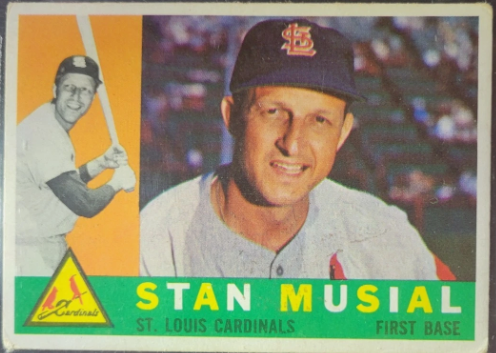
Stan Musial is no slouch at all when it comes to baseball legends. He was one of the most widely recognized players in the 1950s, particularly in the South and West where there were no MLB teams after St. Louis. This means he is far from overlooked. Musial ended his career with a very impressive .331 batting average and he won seven NL batting titles. His at-home and away-game performance at the plate was nearly identical. He led the league twice in RBIs, ended his career ended with 3,630 hits, 1,949 runs scored and 1,951 RBIs. Stan also finished with 475 career homers, which most in the hobby do not consider due to his hitting prowess. He struck out only 696 times while drawing 1,599 walks, for an outstanding OBP of .417. He was named to 24 NL All-Star teams and won three MVP awards (‘43/’46/’48). He spent his entire 22-year career with the Cardinals, split between the outfield and first base, and he won three World Series titles. His Bowman rookie cards even points out that Stan would have been a pitcher had it not been for a shoulder injury.
One interesting aspect about Stan Musial’s collectability is that he has very few mainstream cards from the 1950s compared to other superstar players. His 1948 Bowman and Leaf cards are considered rookies, but there is also a rare Cuban Propogandas Montiel card from 1946-47 (and they can all be very expensive cards). “Stan the Man” then only has the 1949, ’52 and ’53 Bowman cards as his only mainstream cards until late in the 1950s. Even his lower-graded examples of ‘49,53, ’53 won’t break the bank despite not being “cheap” cards.
Why were there no Topps cards for so long when he was one of the best players in baseball? Musial supposedly didn’t want to sign a contract for cards over financial reasons, so with the money ultimately being donated to charity it got him on Topps cards in 1958 — and only the All-Star card at that! Stan’s first regular Topps card was in 1959, with cards each year from 1960-’63 (his final card). These cards are all very reasonably priced even up to mid-grade examples. If Stan Musial had Topps cards in the 1952-55 sets, his collectability and affordability may have been far different on a wider scale.
BROOKS ROBINSON
Brooks Robinson ended his career with a .267 batting average, but he is considered to be one of the greatest third basemen to ever play on the field. His career ended with 2,848 hits, 1,232 runs scored and 1,357 RBIs, and he finished with 268 career homers. He struck out 990 times and drew 860 walks, for an OBP of .322. He was named to 18 AL All-Star teams and won the AL MVP award in 1964. Brooks reputation for his fielding is from winning 16 straight Gold Glove Awards at third base — earnings the nickname “The Human Vacuum Cleaner.” He played for all 23 of his seasons with the Orioles and was voted the 1970 World Series MVP.
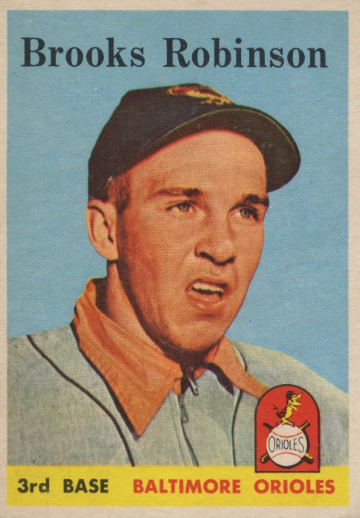
The only truly expensive early Brooks Robinson card is his 1957 Topps rookie card (which also says he can fill in as a catcher). His 1967 Topps is a high-number series (#600) and its price also escalates quickly and surprisingly versus his other 1960s cards. Most of the “other Brooksie” cards by Topps are very affordable from 1959 into the 1970s. Even his 1958 Topps issue as his second card, which happens to be perhaps one of the ugliest facial expressions (shown above) of all 1950s HOF cards, is very affordable low to mid-grades. Some of his cards might even be dubbed dirt-cheap in the 1960s-70s. His final 1978 Topps #4 Record Breaker showed that 1977 was his 23rd season with the Orioles, setting a new player record for number of seasons with the same team.
FRANK ROBINSON
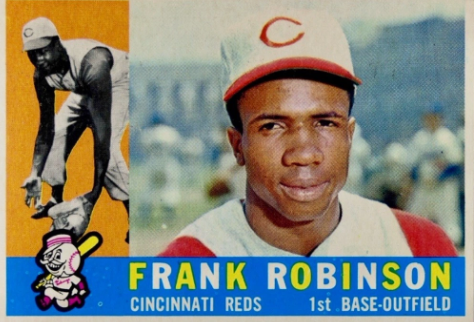
Frank Robinson started strong by winning Rookie of the Year in 1956 and he and won a Gold Glove in 1958. “The Judge” ended his career with a .294 batting average and hit over 40 homers three different seasons. He won the AL Triple Crown in 1966, leading the league in homers and RBIs. His career ended with 2,943 hits, 1,829 runs scored and 1,812 RBIs, and he finished with 586 career homers. Frank struck out 1,532 times but drew 1,420 walks, with an OBP of .389. He was named to 14 All-Star teams and remains the only player to win MVP in both leagues (‘61 NL/’66 AL). He played mainly in the outfield, with time at first base.
Robinson played with the Reds until 1965, but he was traded to the Orioles for the 1966 season — where he became teammates with Brooks Robinson and just in time to win the Triple Crown. Robinson’s final years in baseball took him briefly to the Dodgers, then the Angels, and he finished his career as a player/manager (DH) for the Indians in 1976 playing on 85 games in his last two seasons combined. He also went on to coach and became the first African American MLB team player/manager, ultimately becoming Senior Advisor to the Commissioner and Honorary President of the American League. Robinson’s pedigree was on the field and after his career staying in baseball.
Perhaps the only Frank Robinson card that is actively sought after by collectors is his 1957 Topps rookie, and even this card is rather inexpensive in lower grades. His 1958 and’59 Topps cards will not break a collector’s bank by any means, and most of his cards from 1960s into the 1970s are affordable up to mid-grade examples (and higher-grade examples in later years). Why Robinson is not more collectable is a conversation that has come up with dealers and collectors alike at card shows.
***********
Finally, after 3000+ words you have reached the end. Now go collect the cards and players you want to collect, and don’t worry about what other people think about your collection.
Al Kaline, Brooks Robinson, Ernie Banks, Frank Robinson, Hank Aaron, Harmon Killebrew, Mickey Mantle, Roberto Clemente, Ted Williams, Willie Mays, Yogi Berra
